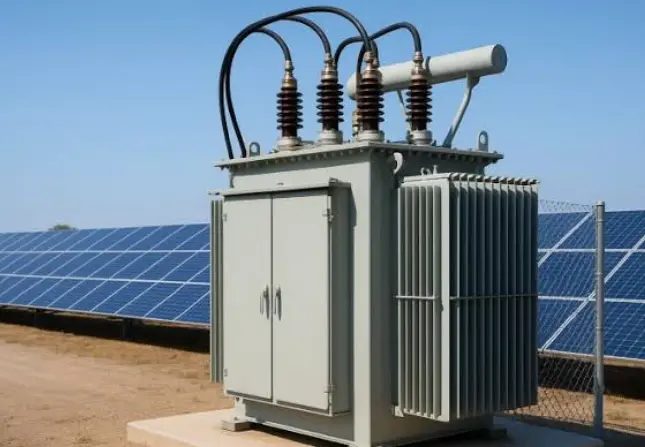
A solar power transformer is an electrical transformer used in a photovoltaic power system to change voltage levels, support grid connection, provide electrical isolation, and help transfer solar-generated electricity safely and efficiently. It is commonly used between solar inverters, distribution equipment, and the utility grid.
In a solar project, photovoltaic modules generate DC electricity. The inverter converts that DC power into AC power. After conversion, the AC voltage may need to be stepped up or adapted before it can be used by a facility or delivered to the grid. This is where a solar power transformer plays an important role.

Why Solar Power Systems Need Transformers
Solar power plants and commercial photovoltaic systems often produce electricity at a voltage that does not match the grid or site distribution voltage. A transformer solves this mismatch by stepping voltage up or down.
For example, an inverter may output low-voltage AC such as 400V, 480V, 600V, or 800V. A transformer can step this voltage up to medium voltage, such as 6kV, 10kV, 11kV, 13.8kV, 33kV, or another grid-required level.
This voltage conversion helps reduce current during transmission, lower cable losses, and make the solar system compatible with local electrical infrastructure.
How a Solar Power Transformer Works
A transformer works through electromagnetic induction. It has primary and secondary windings placed around a magnetic core. When AC flows through the primary winding, it creates a magnetic field. This field induces voltage in the secondary winding.
The turns ratio between the windings determines whether the transformer steps voltage up or down.
In a solar power system, the transformer may perform several functions:
- Step up inverter output voltage for grid connection
- Step down voltage for local loads
- Provide isolation between inverter and grid
- Support grounding system design
- Reduce certain electrical disturbances
- Improve compatibility with switchgear and protection systems
A solar power transformer must be selected according to the inverter, grid voltage, system capacity, and site conditions.
Main Types of Transformers Used in Solar Projects
Inverter Step-Up Transformer
This is one of the most common transformer types in solar power plants. It steps up the AC voltage from the inverter to a medium-voltage level suitable for collection systems or grid interconnection.
Pad-Mounted Transformer
Pad-mounted transformers are commonly used outdoors in commercial and utility-scale solar farms. They are installed on concrete pads and connected to underground or above-ground cables.
Dry-Type Transformer
Dry-type transformers use air cooling and solid insulation instead of oil. They are often used indoors or in areas where oil containment is a concern.
Oil-Immersed Transformer
Oil-immersed transformers use insulating oil for cooling and insulation. They are widely used in larger outdoor solar projects because they can handle higher capacities and provide efficient thermal performance.
Isolation Transformer
An isolation transformer separates electrical circuits while transferring power. In solar applications, it may be used where electrical isolation, grounding control, or equipment compatibility is required.
Key Features of a Solar Power Transformer
Solar applications create specific operating conditions, so transformer design matters.
Important features include:
- High efficiency
- Suitable voltage ratio
- Correct kVA or MVA capacity
- Compatibility with inverter output
- Strong insulation system
- Proper cooling design
- Low losses
- Grid-compliant grounding arrangement
- Outdoor weather protection when required
- Resistance to harmonics and thermal stress
- Reliable protection coordination
- Long service life
Because solar production changes throughout the day, the transformer may experience fluctuating loads. It should operate efficiently not only at full load, but also under partial-load conditions.
Solar Transformer vs. Standard Transformer
A solar transformer may look similar to a standard distribution transformer, but its working conditions can be different.
Solar transformers often deal with:
- Frequent load variation
- Inverter-generated harmonics
- High daytime output and low nighttime load
- Outdoor exposure
- Grid interconnection requirements
- Reverse power flow in some systems
- Thermal cycling
- Remote installation environments
For these reasons, transformer selection should consider the complete solar power system, not just voltage and capacity.
How to Size a Solar Power Transformer
Sizing depends on the total inverter output, AC voltage, power factor, grid voltage, overload requirement, ambient temperature, and system design.
A practical selection process should review:
- Total inverter AC capacity
- Primary voltage
- Secondary voltage
- Phase and frequency
- kVA or MVA rating
- Impedance
- Cooling method
- Temperature rise
- Harmonic content
- Grounding method
- Protection devices
- Installation altitude
- Ambient temperature
- Indoor or outdoor location
- Applicable standards
A transformer that is too small may overheat or limit system output. A transformer that is too large may increase cost and reduce efficiency at light load. The best size balances safety, efficiency, and long-term operation.
Where Solar Power Transformers Are Used
Solar power transformers can be found in many photovoltaic applications, including:
- Utility-scale solar farms
- Commercial rooftop PV systems
- Industrial solar systems
- Solar-plus-storage projects
- Microgrids
- Agricultural solar installations
- Ground-mounted solar arrays
- Hybrid renewable energy systems
- Grid-tied inverter stations
In small residential systems, a separate transformer may not always be visible because the inverter and grid connection design may handle voltage requirements differently. In larger systems, transformers are usually essential.
Maintenance Considerations
A solar power transformer should be inspected regularly to maintain safe and efficient operation. Maintenance requirements vary by transformer type and installation environment.
Common checks include:
- Temperature monitoring
- Oil level and oil condition for oil-filled units
- Insulation resistance
- Connection tightness
- Grounding condition
- Cooling system condition
- Noise and vibration
- Signs of overheating
- Moisture ingress
- Corrosion
- Protective device operation
Proper maintenance can reduce downtime and extend transformer service life.
Common Mistakes to Avoid
One common mistake is choosing a transformer based only on capacity. Voltage ratio, impedance, grounding, harmonics, losses, and installation environment are also important.
Another mistake is ignoring inverter characteristics. Inverter output may contain harmonic components and switching effects that require suitable transformer design.
A third mistake is overlooking efficiency at partial load. Solar systems may operate at varying output levels, so low-loss performance can affect long-term energy yield.
Conclusion
A solar power transformer is a key electrical component that changes voltage levels, supports grid connection, provides isolation, and helps solar energy move safely from inverters to users or the utility network.
The right solar power transformer should match the photovoltaic system capacity, inverter output, grid voltage, grounding method, cooling requirement, and site environment. Careful transformer selection improves system reliability, energy efficiency, and long-term solar project performance.
For solar power transformer product information, visit JS Ningyi.