A 12V transformer is usually an AC device. In the strict electrical sense, a transformer works with alternating current and changes AC voltage from one level to another. For example, a traditional 12V transformer may step 120V AC, 230V AC, or another AC input down to 12V AC.
However, many people use the word “transformer” casually to describe any device that converts mains power into 12V output. This can create confusion. If the output is 12V DC, the device is not only a transformer. It is usually a power supply, adapter, driver, or converter that includes rectification and regulation. This is why a product described as a 12 v dc transformer should be checked carefully to confirm whether it outputs AC or DC.
What Does a Transformer Actually Do?
A transformer transfers electrical energy between two windings through electromagnetic induction. It can step voltage down, step voltage up, or provide isolation between circuits.
A basic transformer has:
- Primary winding
- Secondary winding
- Magnetic core
- Insulation system
- Terminals or leads
- Enclosure or mounting structure
A transformer requires AC input because a changing magnetic field is needed to induce voltage in the secondary winding. Pure DC does not create the same continuously changing magnetic field in a standard transformer.

Is 12V Output AC or DC?
The answer depends on the product.
A 12VAC transformer outputs alternating current. This is common in landscape lighting, doorbells, pool lights, some control systems, and older low-voltage lighting systems.
A 12VDC power supply outputs direct current. This is common in LED strips, CCTV cameras, routers, control boards, sensors, motors, and electronics.
If a label says “Output: 12V AC,” it is an AC transformer. If it says “Output: 12V DC,” it is a DC power supply or adapter, even if some sellers call it a transformer.
What Is a 12 V DC Transformer?
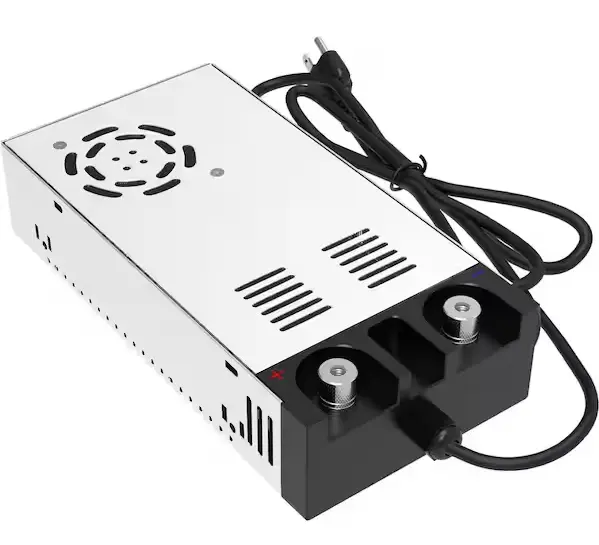
The phrase 12 v dc transformer is widely used in everyday product searches, but technically it usually refers to a 12V DC power supply. Inside the device, there may be a transformer or high-frequency switching circuit, plus components that convert AC into DC.
A typical 12V DC power supply may include:
- Input protection
- Transformer or switching circuit
- Rectifier
- Filter capacitor
- Voltage regulation circuit
- Output protection
- Enclosure and terminals
The rectifier changes AC into DC, while the regulator helps keep the voltage stable.
How to Read the Label
The fastest way to identify AC or DC output is to check the product label.
Look for:
- Output voltage
- AC or DC symbol
- Current rating
- Wattage
- Input voltage
- Polarity marking
- Frequency
- Safety certification
- Indoor or outdoor rating
The AC symbol may appear as a wavy line. The DC symbol may appear as a straight line with a dashed line below it. A DC power supply often shows polarity, such as center-positive or center-negative, for barrel connectors.
Why AC vs. DC Matters
Using the wrong output type can damage equipment or prevent it from working.
For example, a 12V AC landscape light may work with a 12VAC transformer, but a 12V DC LED strip usually needs a 12VDC power supply. A 12V DC camera connected to 12V AC may fail. A 12V AC device connected to DC may not operate correctly.
Before connecting any device, confirm:
- Required voltage
- AC or DC requirement
- Current draw
- Connector type
- Polarity for DC
- Indoor or outdoor use
- Load type
- Installation environment
Common Uses of 12VAC Transformers
12VAC transformers are often used for low-voltage systems that do not require direct current.
Common applications include:
- Landscape lighting
- Doorbell systems
- Some irrigation controllers
- Pool and spa lighting
- Low-voltage halogen lamps
- Certain HVAC control systems
- Alarm circuits
- Industrial control circuits
These systems may be designed specifically for AC operation.
Common Uses of 12VDC Power Supplies
12VDC power supplies are common in electronics and modern low-voltage equipment.
Typical uses include:
- LED strip lights
- Security cameras
- Access control systems
- Routers and modems
- Sensors
- Small DC motors
- Automation controllers
- Audio equipment
- Battery charging support circuits
- Electronic displays
For these applications, a 12 v dc transformer should provide stable DC output with enough current capacity for the connected load.
Linear vs. Switching 12V Power Devices
Low-voltage power devices may use linear or switching designs.
Linear Transformers
A linear transformer is usually heavier because it uses an iron core operating at mains frequency. It may output AC directly, or it may be part of a linear DC power supply with rectification and filtering.
Switching Power Supplies
A switching power supply is usually smaller and lighter. It converts electricity at high frequency and can provide regulated DC output efficiently. Many modern 12VDC adapters use switching technology.
Both types can be useful, but the correct choice depends on the load, noise sensitivity, efficiency requirement, and installation conditions.
How to Choose the Right 12V Device
When selecting a 12V transformer or power supply, consider:
- Does the equipment require AC or DC?
- What voltage tolerance is allowed?
- How many amps are needed?
- What total wattage is required?
- Is the load continuous or intermittent?
- Is the device indoor or outdoor?
- Does it need waterproof protection?
- Does DC polarity matter?
- Is overcurrent protection required?
- Does the installation need isolation?
- Are local electrical rules applicable?
For LED lighting and electronics, choose a regulated 12VDC power supply. For AC lighting or control systems, choose a properly rated 12VAC transformer.
Sizing a 12V Transformer or Power Supply
Power capacity is usually calculated with watts or volt-amps.
For DC loads:
Watts = volts x amps
For example, a 12V DC device drawing 5 amps needs about 60 watts. It is usually wise to choose a power supply with extra capacity rather than running it continuously at its maximum rating.
For AC transformer loads, VA rating is commonly used. A 12VAC transformer rated at 100VA can supply about 8.3 amps at 12V under rated conditions.
Safety Considerations
Low voltage does not mean no risk. A 12V system can still overheat wires, damage equipment, cause sparks, or create fire hazards if overloaded or wired incorrectly. The primary side of the transformer or power supply may also connect to dangerous mains voltage.
Installation should follow product instructions and applicable electrical requirements. Outdoor systems should use suitable weather-resistant enclosures and wiring methods.
Conclusion
A true 12V transformer normally outputs 12V AC. If a device outputs 12V DC, it is usually a power supply, adapter, driver, or converter, even if it is commonly called a transformer.
The key is to check the label and match the output to the equipment. A 12 v dc transformer search usually points to a 12V DC power supply, while a 12VAC transformer is used for AC low-voltage systems. Choosing the correct AC or DC output helps protect equipment, improve reliability, and support safer installation.
For transformer and low-voltage power product information, visit JS Ningyi.