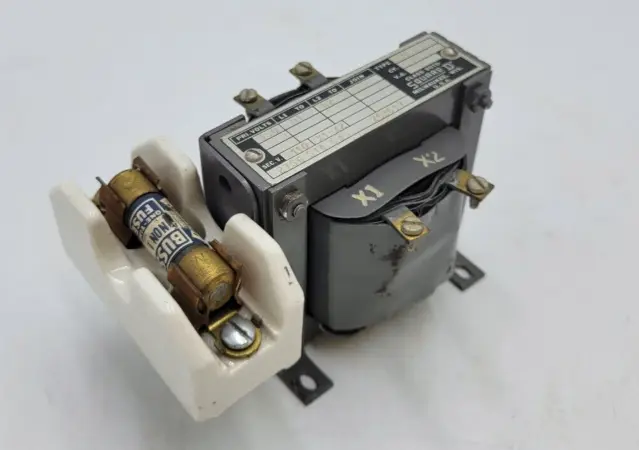
Yes, 30-amp and 50-amp transformer applications are common. However, transformers are not usually selected by amperage alone. They are primarily rated in volt-amperes (VA) or kilovolt-amperes (kVA), together with their primary voltage, secondary voltage, phase, frequency, and intended use.
A 50 amp transformer is therefore not one universal product. Its required size changes significantly depending on the output voltage and whether the system is single-phase or three-phase. A transformer that supplies 50 amps at 24 volts is very different from one that supplies 50 amps at 240 volts.
The right question is not simply, “Do I need a 50-amp transformer?” It is, “What voltage, phase, load type, duty cycle, and current does my equipment require?”
How Transformer Current Ratings Work
Transformer capacity is based on apparent power.
For a single-phase transformer:
VA = Voltage x Current
For a three-phase transformer:
VA = Voltage x Current x 1.732
Schneider Electric’s transformer sizing guidance uses these same principles: single-phase VA is calculated from volts multiplied by amps, while three-phase VA includes the square root of three factor. Schneider Electric’s current-rating formula also explains how VA, voltage, and phase determine transformer current.
This means the same current rating can require very different transformer capacities at different voltages.
What Size Transformer Is Needed for 50 Amps?
The table below shows approximate full-load capacity examples. These examples are for basic sizing illustration only; final equipment selection must consider inrush current, continuous loading, protection, temperature, installation conditions, and applicable electrical codes.
| Output Configuration | Approximate Transformer Capacity |
|---|
| 12 V, single-phase, 50 A | 600 VA |
| 24 V, single-phase, 50 A | 1.2 kVA |
| 48 V, single-phase, 50 A | 2.4 kVA |
| 120 V, single-phase, 50 A | 6 kVA |
| 240 V, single-phase, 50 A | 12 kVA |
| 480 V, three-phase, 50 A | About 41.6 kVA |
For example, a 240 V single-phase 50 amp transformer needs approximately 12,000 VA, or 12 kVA, at full rated load. In contrast, a 24 V transformer supplying 50 amps needs only 1,200 VA, or 1.2 kVA.
This is why voltage must always be specified when discussing transformer current.
What About a 30-Amp Transformer?
The same principle applies to 30-amp applications.
A 30-amp transformer may be quite small at low voltage or much larger at higher voltage. For example:
- 24 V at 30 A requires about 720 VA.
- 120 V at 30 A requires about 3.6 kVA.
- 240 V at 30 A requires about 7.2 kVA.
- 480 V three-phase at 30 A requires about 24.9 kVA.
A supplier may describe equipment by output current for a specific voltage, but the nameplate should also show the VA or kVA rating, primary voltage, secondary voltage, phase, frequency, and temperature-rise information.

Common Applications for 30-Amp and 50-Amp Transformers
Transformers in this range can be used in a wide variety of applications, including:
- Industrial control panels
- Machine tools and automation equipment
- Low-voltage lighting systems
- HVAC control circuits
- Battery charging systems
- Pumps, fans, and motor-related controls
- Commercial equipment with step-up or step-down voltage needs
- Building distribution and isolated power applications
The transformer type must match the application. A small control transformer is not a substitute for a distribution transformer, and a transformer designed for intermittent control loads may not be suitable for continuous high-current service.
What Specifications Should You Provide When Requesting a Quote?
To source the correct 30-amp or 50 amp transformer, provide a complete requirement rather than only an amp value.
Key information includes:
- Primary input voltage
- Secondary output voltage
- Single-phase or three-phase configuration
- Required output current
- Required VA or kVA capacity
- Frequency, such as 50 Hz or 60 Hz
- Load type, including resistive, inductive, electronic, or motor-related loads
- Indoor or outdoor installation environment
- Isolation, step-up, step-down, or control-transformer requirement
- Enclosure and mounting requirements
- Applicable standards, certifications, and electrical code requirements
For industrial projects, buyers should also confirm whether the transformer must handle high inrush current from contactors, solenoids, motors, or other inductive loads.
Do Not Confuse 50 VA With 50 Amps
One frequent source of confusion is the difference between 50 VA and 50 amps.
A 50 VA transformer is a small transformer. At 24 V, its approximate maximum current is only:
50 VA / 24 V = 2.08 A
It cannot provide 50 amps at 24 V. To provide 50 amps at 24 V, the transformer would need roughly 1,200 VA before considering design margin and actual operating conditions.
Always check the nameplate rating carefully. The label should identify the VA or kVA capacity as well as the voltage and current values for the primary and secondary sides.
Safety and Installation Considerations
Transformer sizing is only one part of electrical design. Conductors, disconnects, fuses, circuit breakers, grounding, enclosure type, short-circuit rating, and overcurrent protection must also be selected correctly.
Do not choose a 50 amp transformer only because the downstream circuit uses a 50-amp breaker. The transformer’s capacity and protection requirements must be evaluated as part of the complete electrical system by a qualified electrical professional and in accordance with applicable local regulations.
Final Thoughts
Yes, 30-amp and 50-amp transformer solutions are available, but amperage alone does not define the correct transformer. The required size depends on voltage, phase, VA or kVA capacity, load characteristics, operating environment, and safety requirements.
For accurate selection, start with the load voltage and required current, calculate the apparent power, then choose a transformer that meets the complete electrical specification. This approach helps avoid undersizing, overheating, nuisance trips, and costly installation changes.