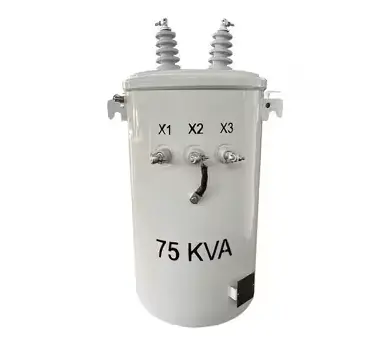
A 75 kVA transformer can serve multiple homes, but there is no universal number of houses that applies to every neighborhood. The correct answer depends on each home’s diversified demand, local voltage, heating and cooling loads, electric-vehicle charging, appliance use, future growth, and utility design standards.
For early planning only, a 75 kVA transformer may serve roughly 10 to 25 homes when the diversified peak demand is estimated between 7.5 kVA and 3 kVA per home. This is not a final engineering recommendation. A utility or qualified electrical engineer should determine the actual number from local load data and applicable standards.
A 75 kVA transformer single phase is commonly used in residential distribution, but its capacity must be matched to the expected coincident peak load rather than the total connected load of every home.
What Does 75 kVA Mean?
kVA means kilovolt-amperes, a measure of apparent power. A 75 kVA transformer has a nameplate capacity of 75,000 VA.
For a single-phase transformer:
kVA = Voltage x Current / 1,000
The current available from the secondary depends on voltage. For example, at a 240 V single-phase output:
75,000 VA / 240 V = approximately 312.5 A
This does not mean the transformer can continuously supply every home at its maximum service rating. Residential transformer sizing relies on realistic demand and diversity, because not every appliance in every home operates at maximum power at the same time.
Schneider Electric’s transformer sizing guidance confirms that single-phase kVA capacity is calculated from voltage and current, while three-phase calculations also include the square-root-of-three factor.

Why the Number of Homes Varies
A 75 kVA transformer can serve very different numbers of homes in different locations. The main factors are outlined below.
1. Diversified Demand
Diversified demand is the estimated coincident load after considering that households do not all reach their maximum demand at the same moment.
For example, one home may be cooking, another may be charging an EV, and another may have minimal load. Utility planners use demand studies and diversity factors to estimate the likely neighborhood peak, rather than simply adding every breaker rating together.
2. Heating and Cooling Type
Homes with electric resistance heating, heat pumps, central air conditioning, or electric water heaters can have much higher peak demand than homes using gas heating and gas water heating.
Climate also matters. A neighborhood with heavy summer cooling demand or winter electric-heating demand may need fewer homes per transformer than a neighborhood with modest seasonal loads.
3. Electric-Vehicle Charging
EV charging can significantly change local transformer loading, especially when several households charge at similar times. Utilities increasingly consider EV adoption and managed-charging strategies when planning residential distribution capacity.
4. Home Size and Appliance Mix
Large homes with multiple HVAC systems, induction ranges, pools, workshops, or high-power equipment may create a greater demand than smaller homes with fewer electric loads.
The service rating of a home alone is not enough to determine transformer loading. A home with a 200 A service does not normally draw 200 A continuously.
5. Future Growth and Utility Standards
Utilities may reserve capacity for future home additions, load growth, electrification, or local voltage-drop limits. Therefore, two utilities may select different transformer sizes for similar housing developments.
Example Planning Scenarios
The following table shows how diversified demand changes the estimated number of homes a 75 kVA transformer may support.
| Assumed Diversified Demand Per Home | Simple 75 kVA Capacity Calculation | Illustrative Number of Homes |
|---|
| 3 kVA per home | 75 / 3 | About 25 homes |
| 5 kVA per home | 75 / 5 | About 15 homes |
| 7.5 kVA per home | 75 / 7.5 | About 10 homes |
These are simplified examples, not design values. A real distribution design must also account for transformer loading limits, conductor capacity, voltage regulation, fault current, ambient temperature, protection coordination, and the utility’s engineering requirements.
Is a 75 kVA Transformer Single Phase Suitable for Homes?
A 75 kVA transformer single phase can be suitable for a residential cluster where the utility uses single-phase distribution and the projected diversified demand fits within the transformer’s capacity.
In North American residential systems, a common configuration is a medium-voltage primary with a 120/240 V split-phase secondary. This arrangement can supply standard household lighting and receptacle loads at 120 V, as well as larger loads at 240 V.
However, the secondary voltage, winding arrangement, primary voltage, cooling method, impedance, insulation class, and installation type must all be specified correctly. A pole-mounted transformer, pad-mounted transformer, and indoor dry-type transformer may each be designed for different environments and applications.
How Utilities Determine Transformer Capacity
Utility engineers generally review more than the number of homes. Their evaluation may include:
- Historical peak-load data for comparable homes
- Expected annual and seasonal demand
- Connected load and demand factors
- Heating, cooling, and water-heating technology
- EV charging adoption
- Local voltage-drop criteria
- Transformer thermal capability
- Primary and secondary conductor lengths
- Future development plans
- Local grid standards and safety requirements
The aim is to provide reliable voltage and capacity during likely peak conditions, while avoiding unnecessary oversizing.
What Can Happen if a Transformer Is Undersized?
An undersized transformer can experience excessive heating, voltage drop, reduced equipment life, and a higher risk of service problems during peak-demand periods. Frequent overload conditions may also affect reliability for customers connected to the same transformer.
Oversizing is not always the best answer either. It can increase installation cost and no-load losses. The most effective design balances present demand, expected growth, reliability targets, and lifecycle cost.
Final Thoughts
A 75 kVA transformer may handle approximately 10 to 25 homes in a preliminary residential planning scenario, but the actual number depends on diversified demand and local engineering requirements.
For a 75 kVA transformer single phase installation, do not base the design solely on the number of homes or each home’s service-panel rating. Use actual load data, account for electrification and future demand, and have the final transformer and protection design confirmed by the serving utility or a qualified electrical engineer.