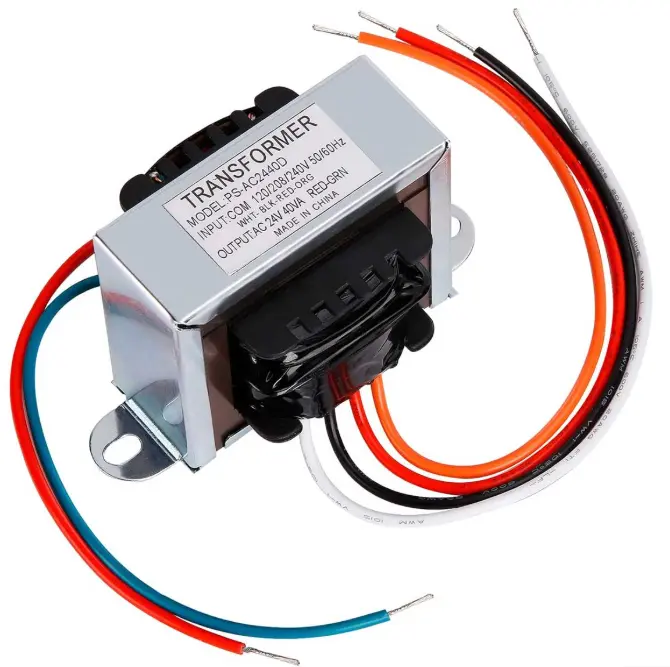
A 120V to 24V transformer is commonly used to convert standard line voltage into low-voltage power for control circuits. It is often found in HVAC systems, thermostats, doorbells, irrigation controllers, relays, access control devices, and industrial control panels. The transformer receives 120V AC on the primary side and provides 24V AC on the secondary side for compatible low-voltage equipment.
Before discussing connection principles, one point is essential: transformer wiring should be performed only by qualified personnel or under local electrical code requirements. Even though the output side is low voltage, the input side is connected to 120V line power, which can cause electric shock, fire, equipment damage, or code violations if wired incorrectly.
What a 120V to 24V Transformer Does
The transformer’s job is to step down voltage. The primary winding connects to the 120V AC supply. The secondary winding outputs approximately 24V AC for the control load. A common example is a 120v 24v 40va transformer, which can supply up to 40 volt-amperes of control power when used within its rating.
This type of transformer does not usually convert AC to DC. It reduces AC voltage. If a device requires 24V DC, a rectifier or power supply is needed instead of a basic AC transformer.

Understanding Primary and Secondary Sides
Most 120V to 24V transformers have two separate sides:
- Primary side: connected to 120V AC line power
- Secondary side: connected to 24V AC control devices
The primary side may include wires or terminals marked for line and neutral. The secondary side may include two low-voltage terminals that deliver 24V AC. Some transformers have multiple primary voltage options, such as 120V, 208V, or 240V. In that case, the correct input terminals must be selected according to the actual supply voltage.
The wiring diagram printed on the transformer label is the authority for that specific model. Wire colors and terminal names can vary between manufacturers, so assumptions should not replace the product diagram.
Basic Connection Principle
In a typical 120V input application, the line conductor connects to the transformer’s 120V primary terminal, and the neutral conductor connects to the other primary terminal specified by the diagram. The secondary side then connects to the 24V load, such as a thermostat circuit, relay coil, control board, or valve control.
For HVAC systems, one secondary terminal is often used as the “R” side of the 24V control circuit, while the other may serve as the “C” common side. However, terminal naming depends on the equipment being connected. The transformer must match the system design.
Power should always be disconnected before installation. The circuit should be verified with a proper meter before touching conductors. After wiring, connections should be enclosed, secured, and protected from strain, moisture, and accidental contact.
Why VA Rating Matters
The VA rating tells you how much apparent power the transformer can supply. A 120v 24v 40va transformer can provide about 40 VA. At 24V, that equals roughly 1.67 amps of available current under ideal rated conditions.
If the connected load requires more than the transformer can supply, the transformer may overheat, voltage may drop, or the control equipment may malfunction. Buyers should add up the VA requirements of all connected loads, including relays, contactors, valves, control boards, and accessories.
It is good practice to leave reasonable capacity margin rather than operate a transformer continuously at its maximum rating.
Common Applications
A 120V to 24V transformer is widely used where low-voltage control is safer and easier to manage than direct line-voltage switching. Common applications include:
- HVAC thermostats
- Furnace control circuits
- Air conditioning contactors
- Doorbell systems
- Irrigation valve controls
- Low-voltage relays
- Access control systems
- Building automation panels
- Industrial control circuits
In these systems, the transformer allows small switches, sensors, and control boards to operate without carrying full line voltage.
Safety Checks Before Installation
Before hooking up a transformer, confirm the following:
- Input voltage matches the primary rating
- Output voltage matches the connected equipment
- VA rating is high enough for the load
- Wiring diagram is available and readable
- Power is disconnected before work begins
- Conductors are correctly sized
- Connections are tightened properly
- The transformer is mounted securely
- The enclosure is suitable for the environment
- Fuse or circuit protection is considered where required
For replacement work, buyers should match voltage, VA rating, mounting style, terminal type, and equipment compatibility. Replacing a failed transformer with an under-rated model can cause repeated failures.
Common Wiring Mistakes to Avoid
Several mistakes can damage a transformer or connected equipment. One common error is connecting 120V power to the secondary side. This can destroy low-voltage components and create a serious hazard.
Another error is using the wrong primary tap on a multi-voltage transformer. If a transformer has terminals for different input voltages, the installer must use the correct pair.
Overloading the transformer is also common. Adding extra accessories to an existing 24V circuit may exceed the transformer’s VA rating. When troubleshooting low-voltage control problems, the load should be checked before replacing parts.
Choosing the Right Transformer
When selecting a 120V to 24V transformer, buyers should consider input voltage, output voltage, VA capacity, frequency, mounting method, enclosure type, insulation class, terminal design, temperature rating, and certification requirements.
For control applications, a 120v 24v 40va transformer is a common choice, but it is not universal. Some systems need 20VA, 50VA, 75VA, or higher depending on the number and type of connected loads.
A reliable transformer should provide stable output, safe insulation, durable construction, and consistent performance under normal operating conditions.
Final Thoughts
Hooking up a 120V to 24V transformer means connecting the 120V AC supply to the primary side and the 24V AC control load to the secondary side according to the manufacturer’s wiring diagram. The work must be done with power disconnected and should follow applicable electrical safety requirements.
The most important selection factors are input voltage, output voltage, VA rating, load demand, mounting method, and equipment compatibility. For many HVAC and control applications, a properly selected 120v 24v 40va transformer provides dependable low-voltage power for thermostats, relays, control boards, and similar devices.
For transformer product information and technical support, visit JS Ningy.