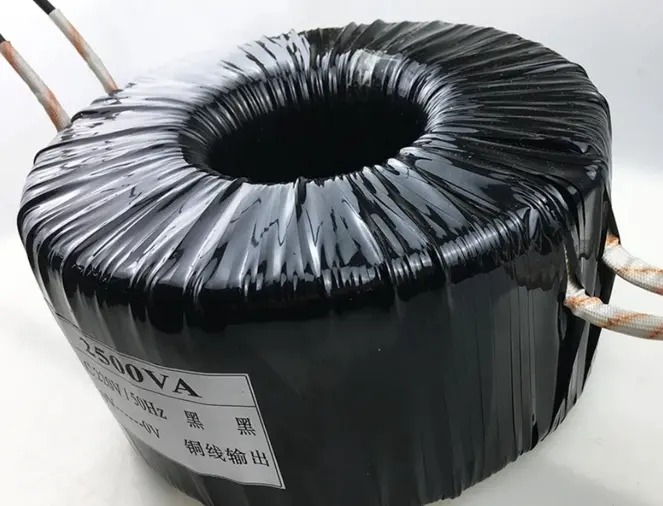
If you have ever opened a high-end audio amplifier, a medical power supply, or a precision industrial control, you have probably noticed a round, donut-shaped component sitting at the heart of the unit. That is a toroidal transformer, and it is far more than a simple voltage converter. In this guide, we explain the real purpose of a toroidal transformer, how it differs from a traditional transformer, and why choosing a high-quality toroidal isolation transformer can improve safety, performance, and reliability in your equipment.
What Is a Toroidal Transformer?
A toroidal transformer is a type of electrical transformer built around a donut-shaped (toroidal) magnetic core made from high-grade silicon steel or amorphous metal. The primary and secondary windings are wound uniformly around this ring, which gives it a more efficient magnetic path than the stacked “E-I” cores used in conventional transformers.
Its compact round shape and symmetrical winding design are not just for looks — they directly affect efficiency, noise, and electromagnetic performance.

The Core Purpose of a Toroidal Transformer
The toroidal transformer serves three main functions:
1. Voltage Conversion (Step Up and Step Down)
Like any transformer, a toroidal transformer changes the voltage level of an alternating current (AC) supply. It can step voltage up or down to match the requirements of the load. Because the toroidal core has a higher magnetic flux density, the same power rating can be achieved with less copper and a smaller, lighter core.
2. Galvanic Isolation — The Heart of the “Toroidal Isolation Transformer”
This is where the toroidal transformer truly shines. A toroidal isolation transformer physically separates the input (primary) winding from the output (secondary) winding, with no direct electrical connection between them. Power is transferred purely through magnetic induction.
This galvanic isolation delivers several critical safety and performance benefits:
- Protection from electric shock: The output side is isolated from the mains, which helps prevent dangerous leakage currents and reduces the risk of electric shock for operators and patients.
- Noise and interference blocking: Isolation stops ground loops and filters out high-frequency noise and harmonics that can travel through a shared ground connection.
- Equipment protection: Sensitive downstream electronics are shielded from surges, spikes, and transients coming from the mains supply.
3. Clean, Stable Power Delivery
By filtering out mains-borne interference and preventing ground-loop currents, a toroidal transformer delivers a cleaner, more stable supply voltage. This matters enormously for audio reproduction, sensitive measurement instruments, and medical monitoring devices.
Why Choose a Toroidal Isolation Transformer Over a Traditional One?
Compared with classic E-I core transformers, a toroidal isolation transformer offers measurable advantages:
- Lower stray magnetic field: The toroidal shape concentrates the magnetic flux inside the core, emitting far less external leakage than a square E-I core. This means less hum picked up by nearby audio circuits or sensitive sensors.
- Quieter operation: Toroidal cores are less prone to mechanical vibration and magnetostriction, so they run noticeably quieter — an important factor in studios, theaters, and medical environments.
- Higher efficiency: Lower core and copper losses mean less energy wasted as heat, better energy efficiency, and cooler operation.
- Lighter and more compact: For the same power rating, a toroidal unit is typically smaller and lighter, making it easier to fit into tight enclosures.
Common Applications of Toroidal Transformers
Because of their clean output and safe isolation, toroidal transformers are widely used where power quality and reliability are non-negotiable:
- Audio and hi-fi equipment — amplifiers, studio monitors, and mixers, where low hum and noise are essential.
- Medical devices — patient monitors, imaging equipment, and surgical instruments that demand galvanic isolation for patient safety.
- Industrial automation and controls — PLCs, servo drives, and measurement systems exposed to harsh electrical environments.
- LED lighting and power supplies — where stable, flicker-free output extends product life.
- Renewable energy and inverters — where clean AC output protects downstream loads.
How to Choose the Right Toroidal Transformer
When selecting a toroidal transformer or a toroidal isolation transformer, keep these factors in mind:
- Power rating (VA): Choose a rating that covers your maximum load with a reasonable safety margin (typically 20–30% headroom).
- Input / output voltage: Confirm the primary and secondary voltages match your application.
- Isolation requirements: If your application demands galvanic isolation, verify the transformer is a true isolation type with proper dielectric strength and insulation class.
- Shielding: A grounded electrostatic shield between windings further reduces common-mode noise.
- Certification and quality: Look for units that meet recognized safety standards and are wound on high-grade cores for consistent performance.
Frequently Asked Questions
Is a toroidal transformer always an isolation transformer? Not always. All toroidal transformers are inherently galvanically isolated, but a unit specifically sold as a “toroidal isolation transformer” is engineered and tested for that purpose, often with reinforced insulation and shielding.
Does a toroidal transformer save energy? Yes. Its low core loss and high efficiency mean less energy is wasted as heat, which can lower running costs in continuously powered equipment.
Why is a toroidal transformer quieter? The toroidal core and uniform winding produce far less magnetostriction and vibration than stacked E-I cores, so audible hum is greatly reduced.
Conclusion
The purpose of a toroidal transformer goes far beyond simple voltage conversion. Its ability to provide galvanic isolation, deliver clean and stable power, and operate quietly and efficiently makes a quality toroidal isolation transformer a smart investment for any application that values safety and performance.
Whether you are upgrading an audio system, designing medical equipment, or building industrial controls, choosing the right toroidal transformer makes a real difference in reliability and output quality.
If you are looking for a trusted supplier of high-quality toroidal transformers and power components, feel free to visit https://www.jsningy.cn/contact-us/ to discuss your requirements with our team.